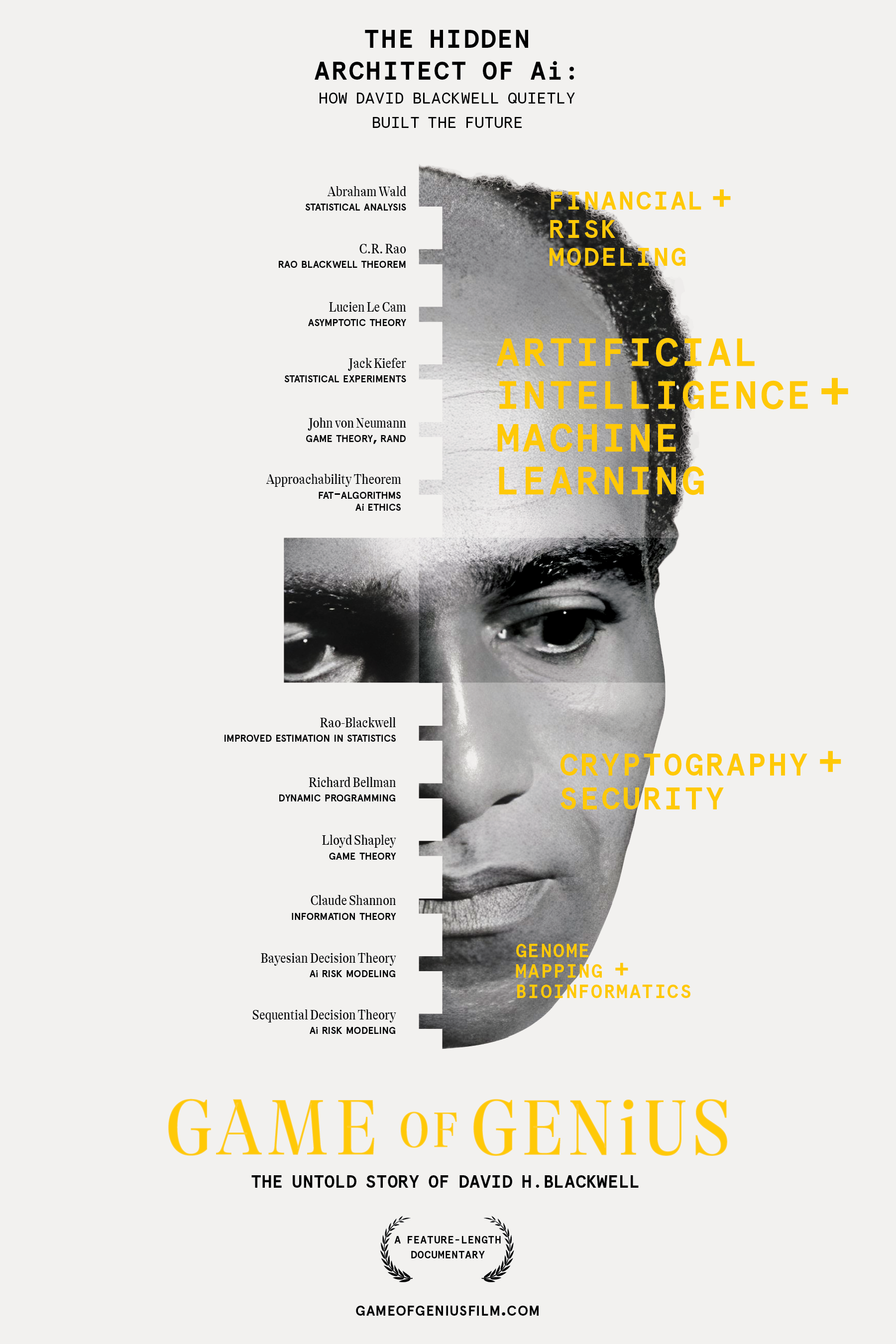
In a domain driven by disruption and defined by some of the most brilliant minds of the last century, Blackwell’s ideas have not only endured—they’ve deepened in relevance. Long after his passing, his theorems continue to guide the frontiers of machine learning and algorithmic design, standing as intellectual bedrock in a field still catching up to his clarity.
David Blackwell Who?
The Hidden Architect of AI
AI was built on four pillars: math, computer science, cognitive science, and philosophy. David Blackwell made foundational contributions to three of them. His work in probability, game theory, and decision-making shaped how machines learn, optimize, and adapt—making modern AI more powerful, fair, and practical.
Blackwell Foundational Methods — Now Critical to AI
BAYSEIAN DECISION FRAMEWORKS
Underpin probabilistic modeling, machine learning, and AI decision-making under uncertainty.
GAME THEORY + MULTI-AGENT SYSTEMS
Inform AI strategy, optimization, negotiation, and learning in interactive environments.
DYNAMIC PROGRAMMING
Foundational to pathfinding, control systems, and the architecture of deep learning models.
SEQUENTIAL DECISION MAKING
Drives adaptive AI, reinforcement learning, and online algorithm development
INFORMATION THEORY + STATISTICAL EXPERIMENTS
Blackwell’s theory of comparing experiments laid the groundwork for understanding information flow in learning systems and model interpretability.
FAIRNESS + APPROACHABILITY IN AI
His Approachability Theorem now informs models aimed at equitable outcomes in AI systems, particularly in the emerging field of algorithmic fairness.